-
 Piaff Dibota
- Blog
- Updated on August 16, 2025
How to Choose a Marketing Agency in 2025!
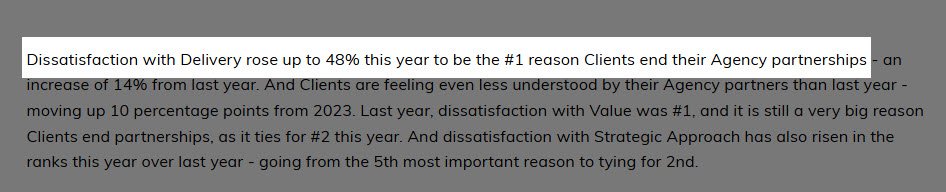
In 2024, 48% of companies surveyed said they were not happy with the deliveries they got from their existing marketing agency. As such, they wanted to change the agency.
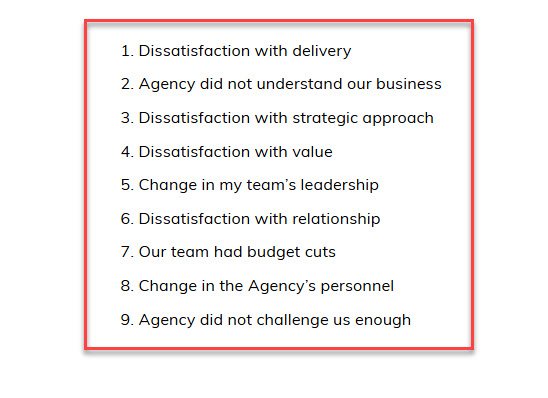
Other reasons included:
- They were not satisfied with the value
- The agency didn’t understand their business
- They were not happy with the strategic approach and
- The marketing agency did not challenge them enough
That’s a report that surveyed 400 companies.
This shows that choosing the right marketing agency is crucial if you don’t want to waste your time, lose money, and regret your choice.
CMOs, marketing directors, revenue directors… how do you choose a marketing agency?
Here are 11 points to consider to avoid making the wrong choice:
- Audit Your “real” problems and goals
- Set your budget range
- Define success metrics
- Research and shortlist potential marketing agencies
- Review relevant case studies
- Ask for revenue outcomes
- Compare pricing plans
- Review their approach to strategy
- Ask if they track first touch, last touch, and assisted
- Align on early wins
- Review fit after 30-60-90 days.
In this article, we will talk about these points and more.
Let’s get started!
Key Takeaways:
- Rank Lyx is a top marketing agency that helps SaaS companies drive more MQLs and SQLs and increase revenue.
- It takes 3 to 6 months to see some results from a marketing agency. But more growth that really increases revenue typically takes 6 to 12 months.
- Companies typically set a marketing budget of $3,000–$20,000 per month for hiring a full-service marketing agency. That’s around $36,000–$240,000 annually.
Table of Contents
Choose a Marketing Agency: Before You Start Searching
Before we jump into how to choose a marketing agency, there are a few things you need to get straight internally.
This part’s on you, and it makes everything else easier.
You’ll want to start by getting honest about the real marketing challenge you’re trying to solve.
Then, set a realistic budget range, and finally, define what success actually looks like for your team and company.
Don’t worry, I’ll walk you through all three, but this step lays all the groundwork.
1. Audit Your Real Problem and Define Your Business Goals
The first thing to do is to find out what’s really going on.
You might think you just need more leads, like 24% of marketers surveyed who said their top challenge is creating content that generates leads. But dig a little deeper.

- Is it that your content isn’t driving traffic?
- Is your email list stale?
- Is sales blaming marketing (again) for poor-quality leads?
I’ve seen businesses hire agencies to run ads when their real problem was messaging. Or push for more content when the issue was poor distribution.
See the difference?
So, before you reach out to any agency, take a step back, look at what’s working, what’s flatlined, and what’s just not moving the needle.
Let’s say your product is solid, but pipeline velocity has slowed.
That might mean your real problem is positioning, not performance. Your business goal, then, might not just be “more leads,” but better-qualified leads from the right ICP.
When you define the problem clearly, the agency knows what they’re solving, and you’re more likely to see real results, not just activity.
So, be honest with yourself. What’s broken, and what outcome are you after?
2. Clarify Your Budget Range
Setting a budget is the next step when choosing a marketing agency.
As the marketing director or CMO, I know budget talk can feel like a headache.
But going into agency conversations without a ballpark budget is like house hunting without knowing what you can afford.
You don’t need an exact figure, but you do need a range.
For example, your budget could be $3,000 a month or $30,000 per quarter. This changes who you talk to and what kind of strategy is realistic.
You need to be absolutely honest about what success is worth.
If hitting your growth goal is a top priority, your budget should reflect that. Otherwise, you risk underfunding the very thing you’re trying to fix.
How much should you set as a budget?
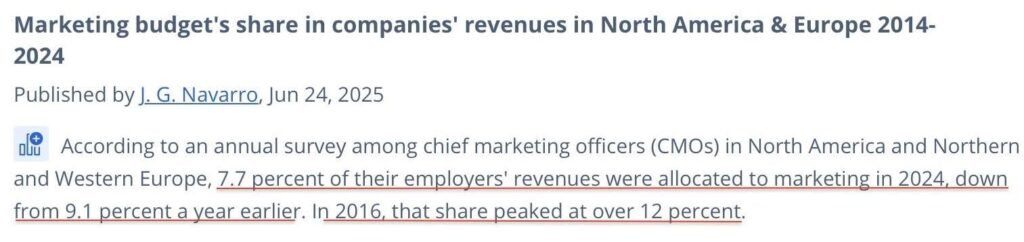
According to a Gartner survey of 395 CMOs and marketing leaders, the average marketing budget is 7.7% of overall company revenue.
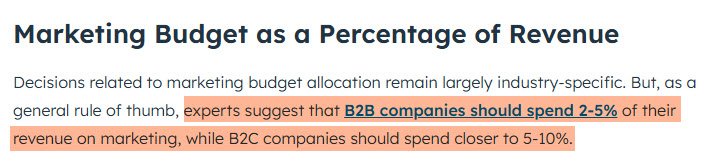
And HubSpot says B2B companies should spend 2-5% of their revenue on marketing, while B2C companies should allocate 5-10%.
But not all companies use a specific percentage.
In terms of cash, companies typically set a marketing budget of $3,000–$20,000 per month for hiring a full-service marketing agency.
That’s around $36,000–$240,000 annually.
3. Define Success Metrics
Here is one last task before choosing a marketing agency: define success metrics.
“We want growth” sounds great, but it’s not a metric.
Before you even speak to an agency, get super clear on what success looks like for your team.
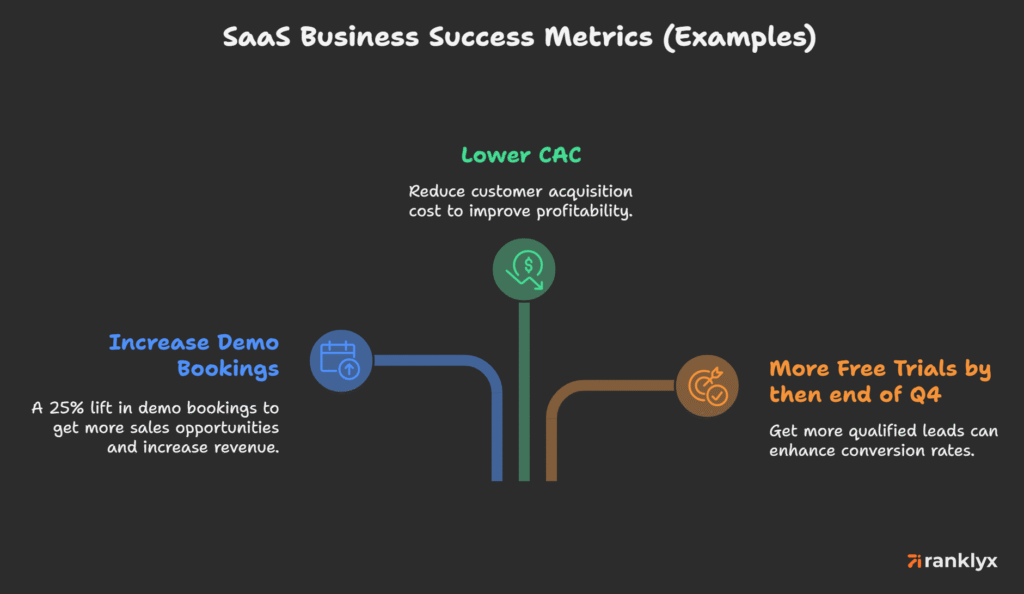
- Is it a 25% lift in demo bookings?
- A lower customer acquisition cost (CAC)?
- More qualified leads in the pipeline by Q4?
If you can’t measure it, you can’t manage it.
I’ve seen projects fall apart simply because no one agreed on what “success” meant from the start.
The agency thinks they’re crushing it with impressions and clicks, meanwhile, you’re wondering why MQLs are still flat.
Don’t let that happen.
Choose metrics that match your real business goals, not vanity numbers. And keep it simple because one or two primary KPIs are better than a laundry list of stats.
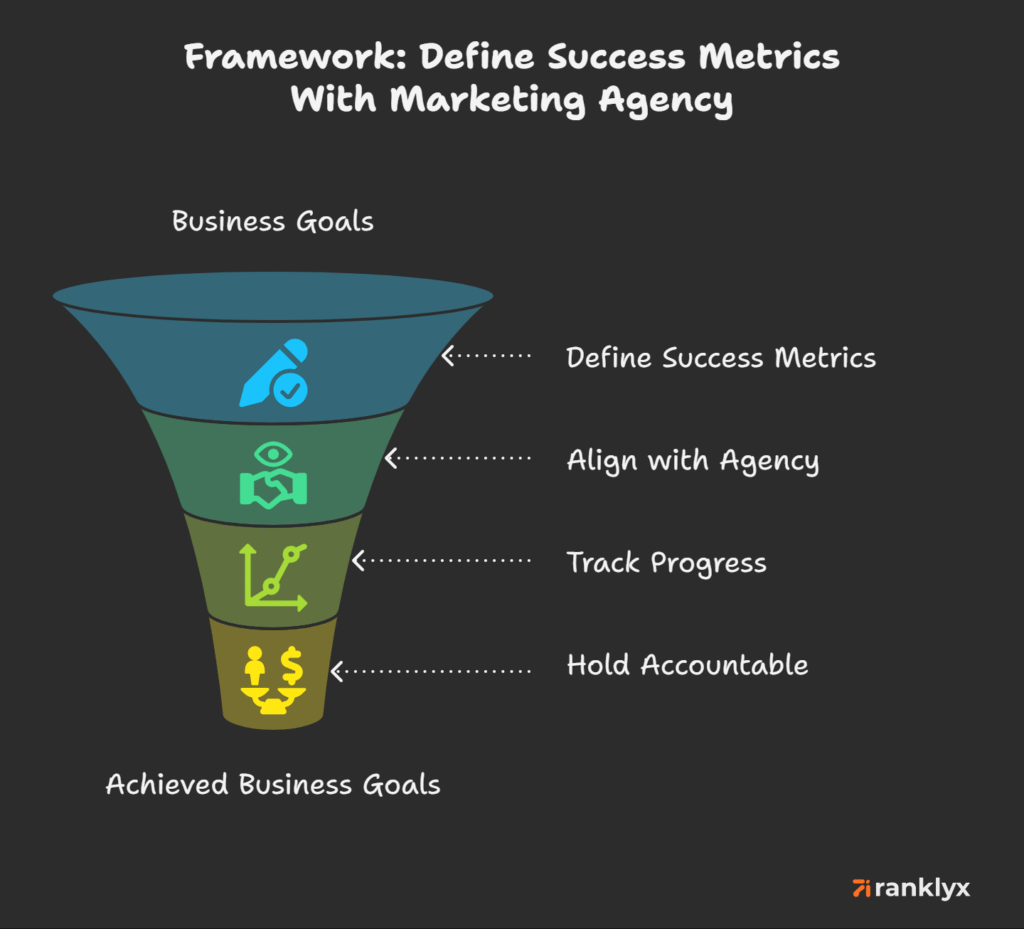
When you define success early, it keeps everyone aligned and makes it easier to hold your agency (and yourself) accountable.
And by the way, 61% of the marketers Forrester surveyed in 2016 “admitted that most of their data work went into reporting on how they did, not showing how marketing drives better business results.”

That’s even more reason not to skip this step.
Choose a Marketing Agency: Selection and Shortlisting
Now that you know what you need, what success looks like, and how much you can spend, it’s time to find an agency.
But don’t choose a marketing agency because they have a slick website or big brand logos on their homepage.
You’ve got to look deeper.
From case studies to conversion tracking and pricing to process, there’s a lot to evaluate. Remember that you want a growth partner, not a vendor.
In this section, I’ll walk you through exactly what to look for (and what to ask) so you can shortlist smartly.
4. Research and Shortlist Potential Marketing Agencies
Shortlisting agencies is the next step when choosing a marketing agency.
This is where the real hunt begins.
You don’t need to scroll through 200 Google results or stalk every agency on LinkedIn.
Start with the basics.
Look for agencies that specialize in your industry (B2B, SaaS, etc.) and have experience solving the kind of problem you’re facing.
If you need better-qualified leads, an agency known for brand awareness campaigns isn’t the right fit.
I recommend shortlisting 3 to 5 solid options.

Look at their websites, but don’t stop there.
Check their blog or LinkedIn.
- Do they practice what they preach?
- Do they talk about strategy or just buzzwords?
One solid example is Rank Lyx, our SaaS marketing agency.
Piaff, our CEO, published an excellent article on how to write a SaaS blog post.
He explained the various steps in detail.
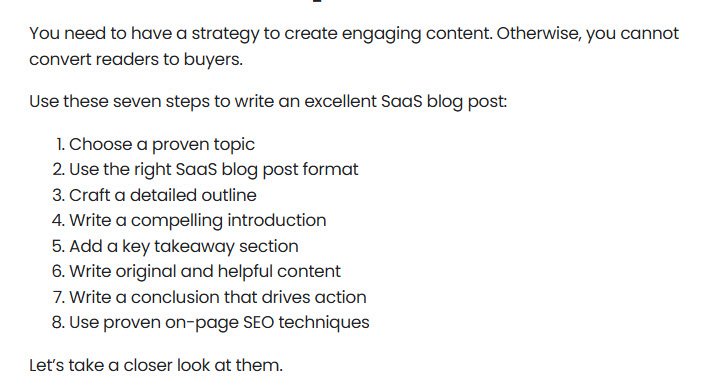
One of those steps — write helpful content — caught my attention.
To provide value in your b2b content, he asked to share case studies, stats, screenshots, and more.
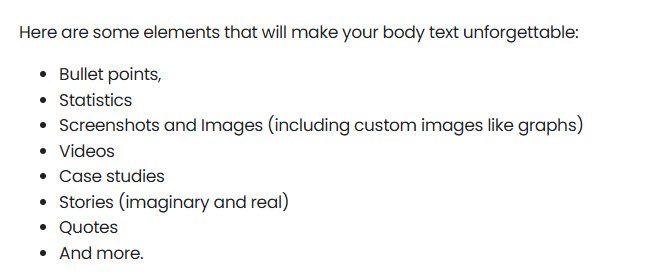
Without a doubt, he does what he preaches, or let’s say, we do what he preaches.
For example, we wrote an article for meetergo about the top meeting scheduling software.
We didn’t just cover each tool without first-hand experience. Our team tested each software, created outcomes, and shared personal experiences.
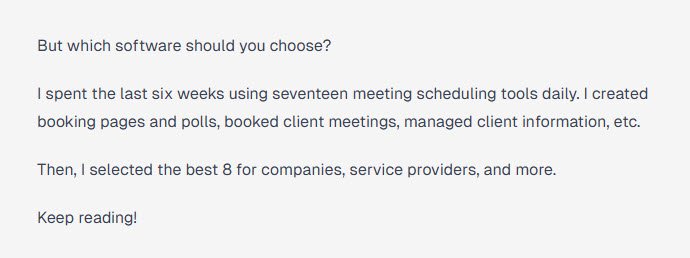
That’s the type of post that ranks and drives conversions.
You can also ask other marketers in your network who they’ve worked with and what results they got. A warm referral beats a cold search every time.
Your goal here isn’t to find the best just yet. You’re narrowing the field to agencies worth having real conversations with.
5. Review or Request Relevant Case Studies
Once you’ve got a shortlist of marketing agencies, dig into the proof.
Ask the marketing services for case studies that are relevant to your business.
If you’re a B2B SaaS company trying to improve lead quality, a case study about boosting Direct-to-Consumer (DTC) eCommerce sales isn’t helpful.
You want to see how they’ve helped businesses like yours solve the kinds of problems you’re facing.
Also, look for specifics like the challenges their client had and what strategy the agency used.
What changed as a result, and how fast?
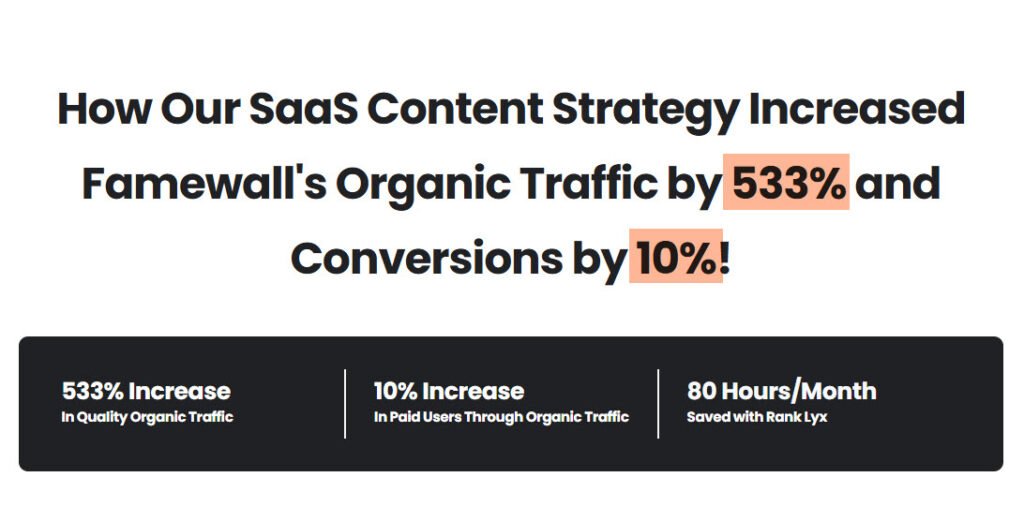
For instance, in our case study about Famewall, we share the problem they were facing before working with us.
They hired freelancers who produced bad or AI content that never ranked.
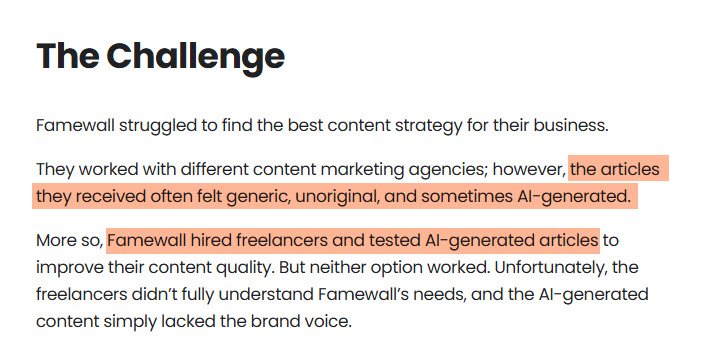
However, working with us increased their traffic by 533% and conversion rate by 10% in just a couple of months.
You want the same level of transparency from any agency you talk to.
6. Ask for Revenue Outcomes, Not Just Traffic Wins
Traffic is great, but that alone won’t pay the bills.
You’re engaging with marketing agencies to drive pipeline and revenue. So when you’re talking to them, dig deeper than vanity metrics.
Ask questions like:
- How did this content strategy impact qualified leads?
- What was the effect on CAC or deal velocity?
- Did any of this contribute to revenue growth?
Some agencies will flood you with charts about impressions and clicks. That’s fine, but they also need to show you real business outcomes.
Tie content performance back to pipeline metrics, demo bookings, SQL growth, lead quality, and ARR (Annual Recurring Revenue).
That’s the level of insight you should expect from any agency worth working with.
You want a partner who understands that traffic is just the start, but revenue is the real win.
7. Compare Pricing and Cost
Once you’ve seen what each agency can do, it’s time to figure out what it’ll cost you (and if it’s worth it).
The first thing you need to understand is that pricing structures vary wildly.
Some agencies charge monthly retainers, others bill by project or hour, and I know one that uses a point system.
Neither is right nor wrong: it depends on your goals and how you prefer to work.
What matters most is whether the pricing matches the scope of work and expected outcomes.
And don’t just look for the cheapest option.
If one agency is quoting $2,000 and another $8,000 for the same deliverables, ask why.
- Are they cutting corners?
- Is one giving you deeper strategic involvement?
So, compare pricing carefully, ask what’s included (and what’s not), and ensure the value aligns with your goals.
And remember that the cheapest agency may save you money now, but cost you growth and revenue.If you are a SaaS company, check out this article on SaaS marketing agency pricing. We break down the cost for you.
8. Review their Approach to Strategy
I strongly believe a marketing agency has to think before they do any work.
So, when you’re evaluating an agency, don’t just focus on execution. Ask how they think.
- Do they take the time to understand your market, audience, funnel, and growth goals?
- Or are they just pitching deliverables?
A strong agency will lead with strategy. They’ll ask the right questions before recommending solutions.
Things like:
- Who’s your ICP?
- Where are they falling off in the funnel?
- What’s worked (or flopped) before?
A high-performing marketing agency won’t just jump into creating content. They’ll ask questions that will make you uncomfortable.
During their research, they’ll start with audience research, funnel gaps, and competitive positioning to ensure every campaign has a purpose.
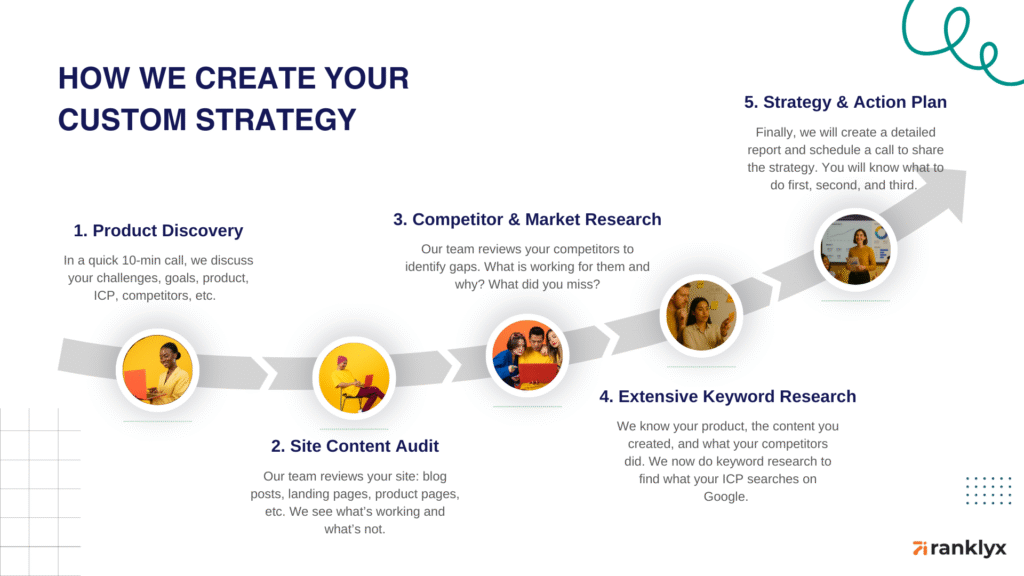
If an agency can’t clearly explain its strategic process, or worse, they don’t have one, that’s not good.
You want partners who can think critically and tie every action to your growth goals.
9. Ask If They Track First Touch, Last Touch, and Assisted
This part might sound a little nerdy, but it really matters.
When you want to invest in a marketing agency, find out what’s working. That’s where conversion tracking comes in.
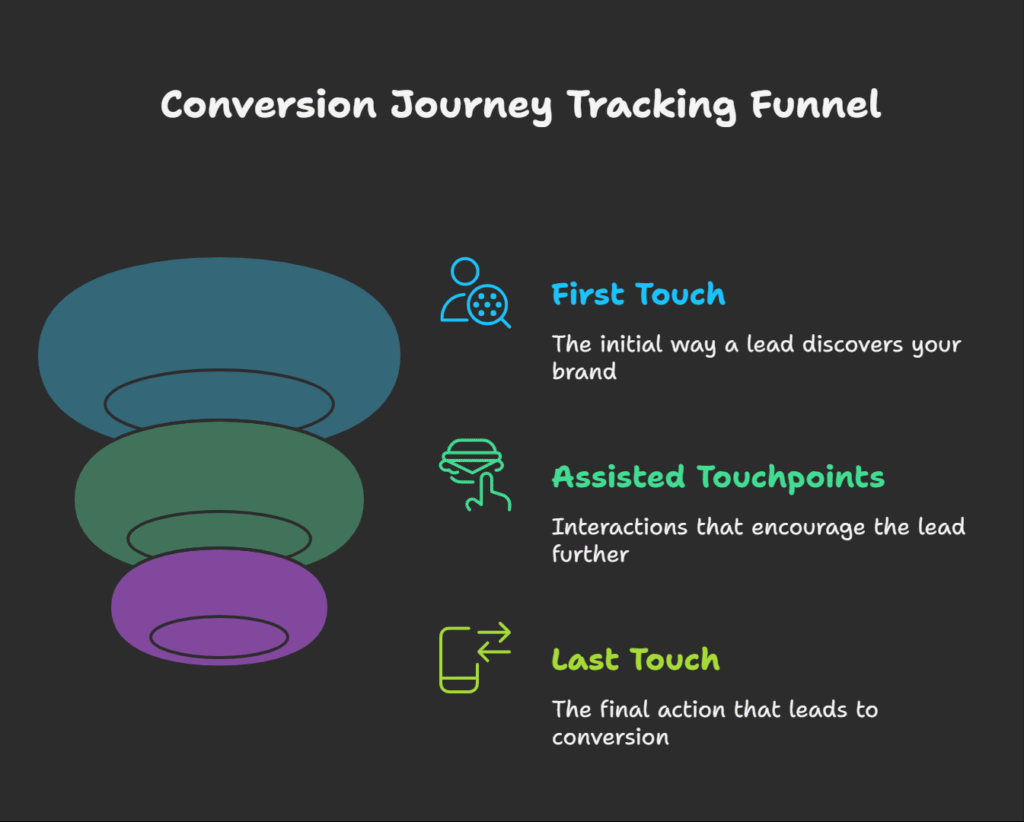
So, ask if the agency tracks:
- First touch (how someone first found you)
- Last touch (the final action before converting)
- Assisted touchpoints (everything in between that nudged them along)
Why does this matter?
Because not all conversions are direct.
Maybe a lead saw a blog post first (first touch), clicked a retargeting ad later (assist), and finally booked a demo from an email (last touch).
If your agency only tracks the last click, you’ll miss what’s really driving pipeline.
You’ll also not know if the collaboration is working well.
But the agency itself will likely talk about this. After all, they want to track and show real results.
That’s the only way to keep you and increase their revenue.
Choose a Marketing Agency: After Selection
You’ve done the research, asked the tough questions, and picked your agency, but the job isn’t over just yet.
Now it’s about setting the partnership up for success.
That means aligning on early wins so it’s clear what progress looks like from day one.
And as the relationship takes shape, you’ll need to review the fit at key checkpoints (30, 60, and 90 days in) to ensure things are working.
In this section, I’ll show you how to handle both so your agency doesn’t just start strong but stays that way.
10. Align on Early Wins
Aligning on early wins is your action when choosing a marketing agency.
They build momentum, boost confidence, and give everyone something solid to point to while the bigger strategy unfolds.
Early wins are great because they boost your trust in the agency. You know that things are working well and can expect even better results in the future.
It’s possible that you and the agency might have very different ideas of what an early win looks like.
So, as the head of marketing, or CMO, it’s up to you to define those wins together.
Maybe it’s publishing your first SEO-driven blog post in 14 days or getting five new demo bookings from a quick PPC campaign.
Whatever it is, it needs to be realistic, measurable, and tied to your bigger goals (SMART goals).
11. Review Fit After 30-60-90 Days
Choosing the right marketing agency isn’t a one-and-done decision.
It’s a relationship you’ve got to check in on regularly to make sure it’s still working.
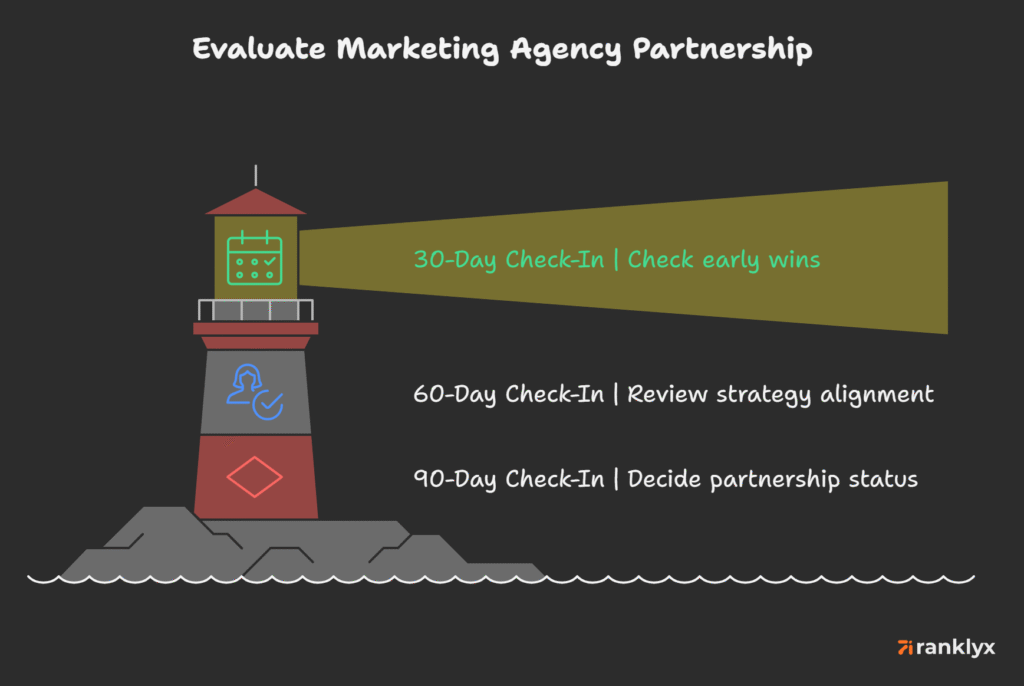
That’s where the 30-60-90 day check-ins come in.
At 30 days, ask,
- Did we hit the early wins we agreed on?
- Is communication smooth?
At 60 days, dig deeper:
- Is the strategy aligned with our goals?
- Are we seeing real traction?
By 90 days, it should be clear whether the partnership is worth continuing or if it needs a reset.
These check-ins don’t have to be formal audits. A simple meeting with honest conversation goes a long way.
Just don’t wait six months to realize it’s not working.
And voilà, you just learned how to choose a marketing agency.
Questions to Ask Marketing Agencies During an Introduction Call
Let’s look at all the questions you can ask potential marketing agencies in the first call:
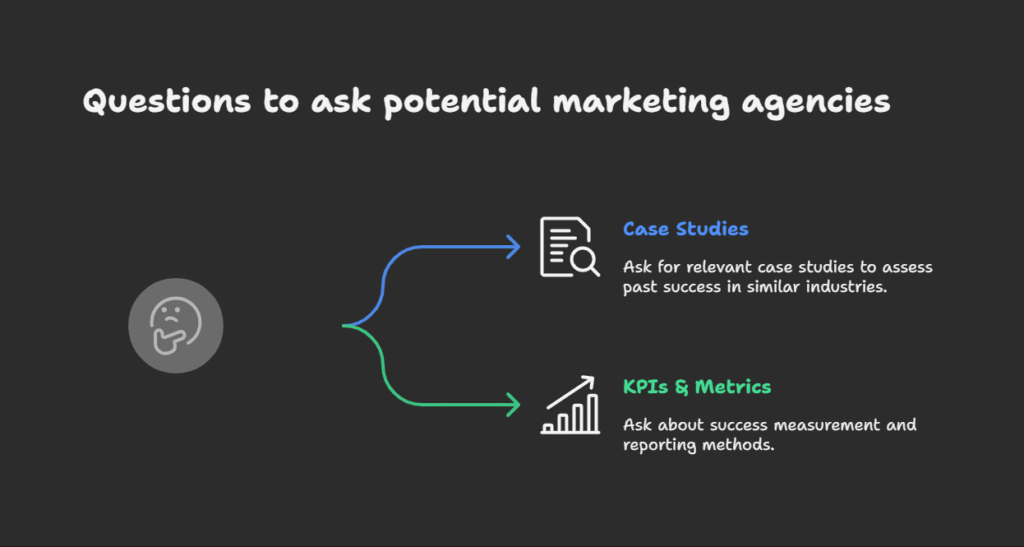
1. Case studies + proof of similar success
- Can you provide case studies relevant to my industry or similar business goals?
- Can you walk me through a campaign where you directly contributed to pipeline or reduced CAC for a client like us?
2. KPIs, success metrics, and reporting
- How do you measure success for your clients, and what KPIs do you prioritize?”
- How do you measure success, and what metrics do you report on?
- How do you handle reporting and attribution?
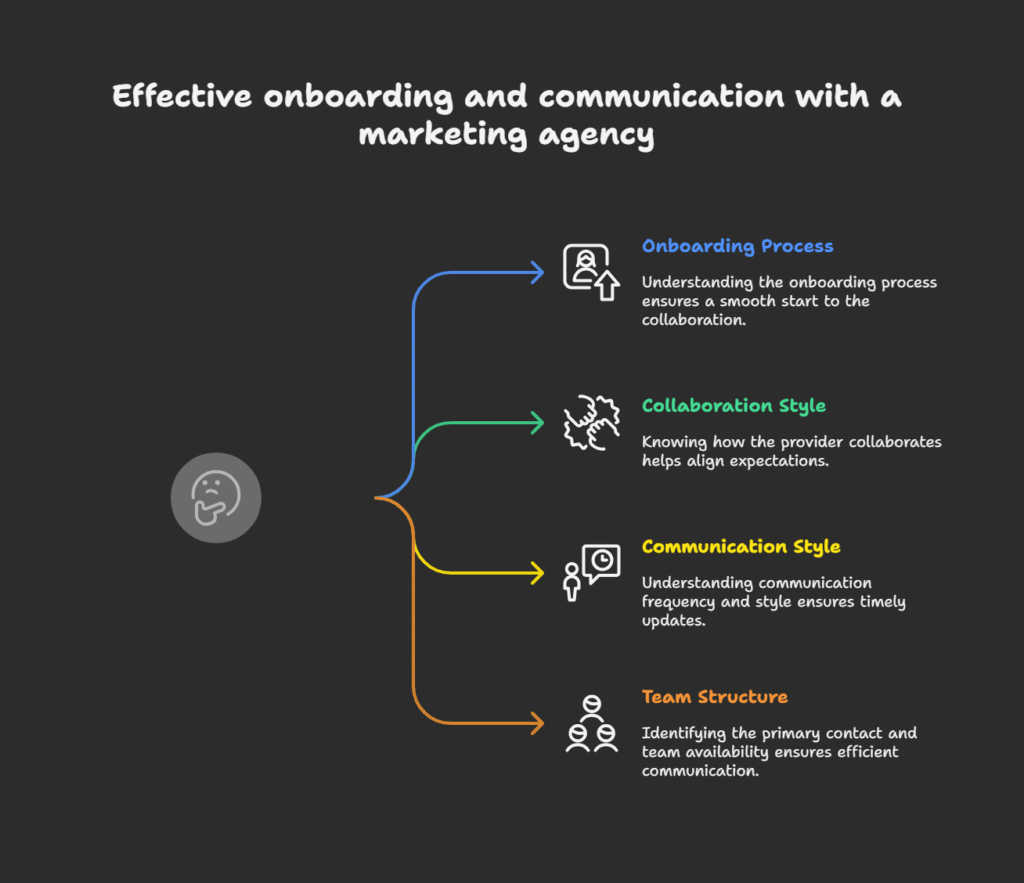
3. Onboarding and collaboration
- What is your typical client onboarding process?
- What does your onboarding process look like?
- How do you typically collaborate with in-house teams?
4. Communication and team structure
- What is your communication style, and how frequently will we receive updates?
- Who will be the primary contact for our account?
- Who will we be working with day-to-day, and what’s your team’s availability?
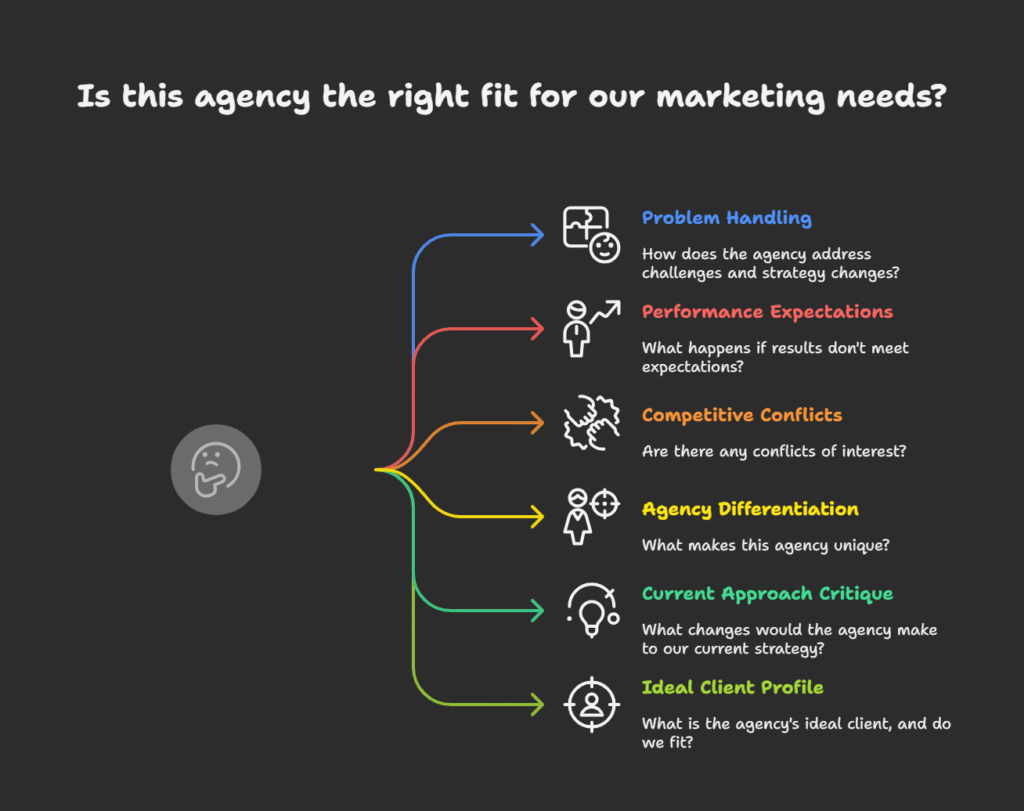
5. Handling problems + long-term fit
- How do you handle unforeseen challenges or changes in strategy?
- What happens if results aren’t meeting expectations after 3 months?
- Do you have any competitive conflicts of interest?
- What sets your agency apart from others?
- What would you stop doing in our current marketing approach?
- What does your ideal client look like, and how do you decide if we’re a fit?
How to Measure the ROI After Working With a Marketing Agency
If you’re spending money on an agency, you need to know it’s moving the needle. Forget about traffic or impressions.
What you want is business-level impact.
To measure the ROI of working with a marketing agency, determine what you spent and what you received in return. If you invested $20,000 over three months and added $100,000 to the pipeline, that’s ROI.
But I’d also look at the bigger picture.
Did it free up your in-house team? Did you stop wasting time on tactics that weren’t working?
That’s value, too.
Also, I usually tell marketing directors like you to focus on metrics that matter, like
- CAC
- SQL growth
- Pipeline velocity
- MQL to SQL conversion rate.
And don’t forget to check alignment.
Is the marketing agency helping you hit your goals, or are they just proud of a traffic spike that doesn’t convert?
ROI is more than just a number: it’s clarity and progress. If you feel more confident and less stressed, that’s a win too.
Pro Tip: Don’t wait for Q4 to check ROI. Set mini check-ins every 30 days to track progress early before small issues turn into expensive regrets.
How Long Does It Take to See Results From a Marketing Agency?
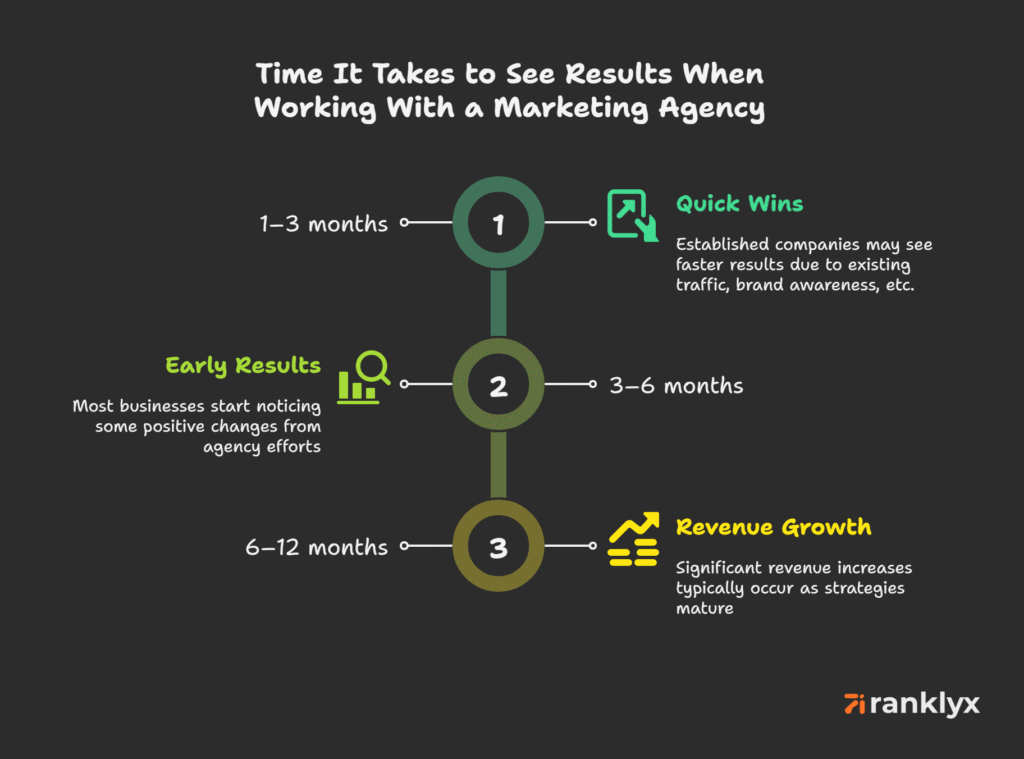
Most businesses start seeing some results from a marketing agency in about 3 to 6 months.
But more growth that really increases revenue typically takes 6 to 12 months.
It depends on the services (SEO is slower, ads are faster), how competitive your market is, and whether you already have a strong foundation in place.
For new companies, results often take longer — usually closer to the 6–12 month range — because they’re starting from scratch with little brand awareness, fewer backlinks, and smaller customer data sets to work with.
Established companies, on the other hand, can see quicker wins (sometimes within 1–3 months).
The reason is they already have traffic, a customer base, and historical data that agencies can optimize and scale.
In-House Team vs Marketing Agency: Which Should You Choose?
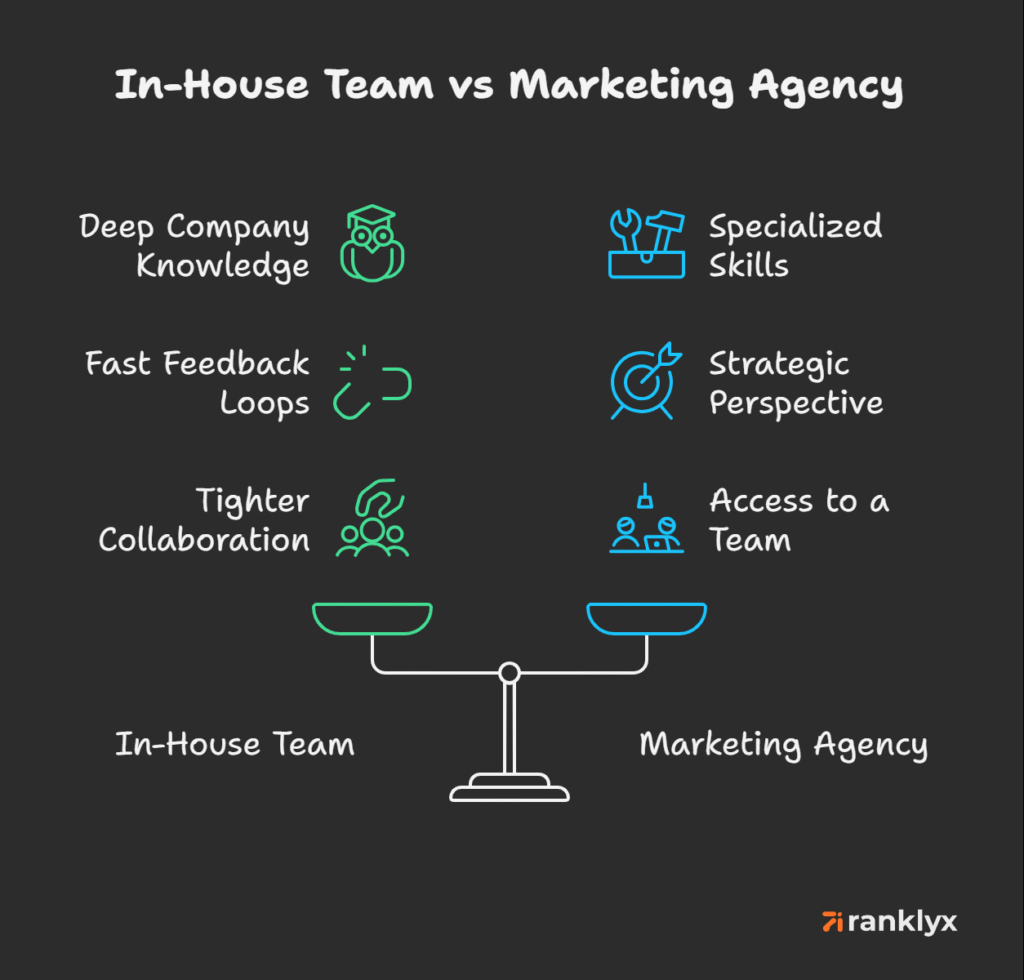
If you need someone embedded in the day-to-day, working closely with sales, product, or customer success, in-house might make more sense.
That team will offer you deep company knowledge, fast feedback loops, and tighter internal collaboration.
But if you need specialized skills, speed, or a fresh strategic perspective, especially in areas like content marketing, paid media, or SEO, a marketing agency is often the smarter option.
You get access to an entire team, not just one person, and you skip the time (and cost) of hiring, onboarding, and training.
Plus, if we talk money, hiring in-house usually means spending $60k–$120k per year per marketer, and if you need a full team (say, content, SEO, paid, design), costs can climb past $300k annually.
A marketing agency typically charges between $3k–$15k per month ($36k–$180k per year).
Choose a Good Marketing Agency
And there you have it!
In this article, I explained how to choose a marketing agency. I shared tips that will help you before, when, and after choosing your partner.
You also learned how to measure ROI after choosing the B2C or B2B agency.
And last but not least, you saw the amount of time to wait before seing real results.
Now is your turn.
What problems do you want to solve?
Answering this question is the first step before more monthly recuring revenue.
And if you are looking for a growth partner, check out Rank Lyx.
We will offer you a free site audit to see what’s working and not. Then, we will create a content strategy to solve your problems