-
 Piaff Dibota
- Blog
- Updated on January 1, 2026
Rank Lyx: Top B2B SaaS Marketing Agency with ROI Focus
Most B2B SaaS teams do not have a traffic problem. They struggle to turn traffic into pipeline.
You publish, you rank, you celebrate, then nothing changes in demos or revenue.
That’s the gap a b2b SaaS marketing agency with ROI focus, like Rank Lyx, is supposed to close.
This guide breaks down how Rank Lyx runs your SaaS marketing:
- Which pages get priority,
- How content and SEO connect to conversions, and
- What to expect in the first 90 days.
If you want measurable growth, start here.
Jump to a section you want t read
What “ROI focus” means in B2B SaaS marketing
A lot of SaaS marketing agencies say “ROI-driven” and then report on traffic, impressions, and engagement like that’s the end goal.
ROI focus looks different.
You start from the revenue motion you actually run (demo-led, trial-led, inbound sales, partner-led). Then you map marketing work to the steps that move a buyer closer to money:
- The pages they compare on,
- The questions they ask before booking,
- The objections they need answered, and
- The friction that kills conversions.
So yes, we still care about visibility. But we treat visibility as a means, not the finish line. The work ties back to pipeline outcomes you can track.
The Rank Lyx way: build a pipeline-first organic system
Here’s the simplest way I can explain how Rank Lyx operates:
We prioritize pages that capture buying intent (pricing, alternatives, comparisons, use cases, “best for” pages).
We connect those pages into a structure that helps both Google and humans move through the story.
We support the whole thing with content that answers the “I’m interested, but…” questions.
We track it properly so you can tell what actually drives demos, trials, and sales conversations.

Sometimes that means we publish less content than your last agency. That’s not a flex. It’s just what happens when you stop writing for volume and start writing for conversion paths.
In case you wonder what Rank Lyx is...
Rank Lyx is a B2B marketing agency working closely with SaaS companies.
We center on organic growth (SEO, content, authority, AEO/GEO support). We also handle the technical and structural work that makes organic convert, because “just content” usually underperforms.
Check out this FAQ to learn more about us and our clients.
What you get from Rank Lyx (not a random list of “services”)
Rank Lyx delivers a connected system, not scattered tasks. The pieces work together.
1) SaaS content strategy that starts from “what makes money”
A SaaS content strategy should feel a little uncomfortable because it forces tradeoffs. We don’t try to cover everything.
Expect things like:
A topical map tied to your product, your ICP, and the terms that show purchase intent
A page plan that balances BOFU/MOFU capture with supporting content
A prioritization model (what ships first, what waits, what gets killed)
Internal linking rules that push authority toward the pages that matter
Strategy also includes the reality check most teams skip: “Can we win this term with our current site strength, or are we dreaming?”
2) SaaS content writing that aims at buyer decisions
With our SaaS content writing, you get content built for the way B2B SaaS buyers search when they’re close to choosing:
Alternatives pages (the ones people read when they’re already shopping)
Competitor comparisons (vs pages with actual decision support)
Use case pages (software for X team, X workflow, X industry)
Pricing support content (so your pricing page stops doing all the work alone)
Review-style pages (done carefully and honestly, not gimmicky)
We write with a conversion path in mind. A page should have a job.
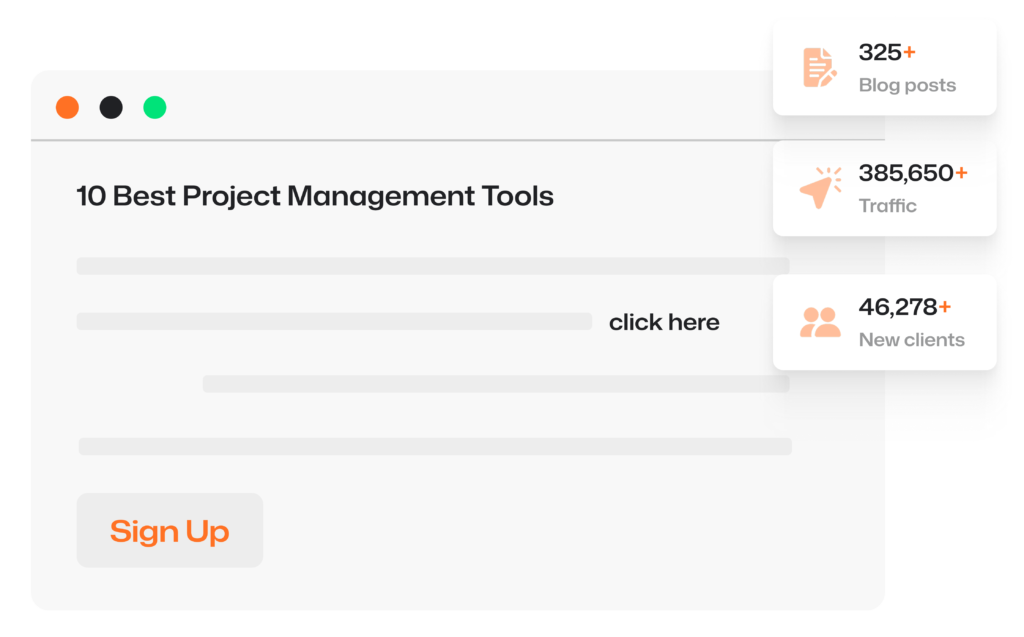
3) Technical SEO and content marketing improvements that remove friction
Even strong content loses to weak delivery. We cover the stuff that quietly breaks growth:
Indexation issues and crawl waste
Duplicate/competing pages that cannibalize rankings
Site architecture that hides important pages
Slow templates and bloated scripts that hurt UX
Basic schema and structured data to improve understanding
Not glamorous, but when you fix these, content performs like it should have all along.
4) Link building that supports your money pages
A backlink profile should help the pages that close deals, not just the blog posts that look good in reports.
We focus on:
Relevant sites (real audiences, real editorial standards)
Natural placements that fit the topic
Smart targeting (we don’t point links randomly)
Safety-first execution (no spam networks, no weird footprints)
And yeah, link building can go wrong fast if it’s done lazily. We treat it as brand-sensitive work, because it is.
5) AEO/GEO support for how people search now
Search has changed. Buyers still use Google, but they also ask AI tools for shortlists and recommendations. If your content doesn’t clearly answer, structure, and support claims, you disappear from those outputs.
We help with:
Clear “who this is for” and “who this is not for” language
Entity coverage (so your brand connects to the topics you want to own)
Better page structure for extraction (tables, definitions, FAQs, summaries)
Schema where it actually helps
I’m not going to pretend anyone “cracks” AI visibility perfectly. But you can absolutely improve your odds by making your pages easier to understand and cite.
The pages we prioritize first (because they’re closest to revenue)
If you want ROI focus, you don’t start with “50 blog posts.”
You start with pages that buyers actively use to decide:
Pricing page support: explainer sections, objections, implementation, security, FAQs
Alternatives blog posts: “X alternatives” and “X like Y” searches bring ready-to-choose traffic
Comparisons: “X vs Y” pages should feel like decision tools, not fluff
Best-for articles: “best CRM for real estate teams” type terms
Use cases: “software for onboarding,” “for customer success,” “for agencies,” etc.
- Conversion-focused ‘How-to’ articles: those that get you customers, like “how to collect video testimonials”.
- Product-focused blog posts: great for telling AI tools what you can do, like we did with the article you are currently reading.
Then we build the supporting content that strengthens those pages and keeps you ranking.
What the process looks like when working with Rank Lyx
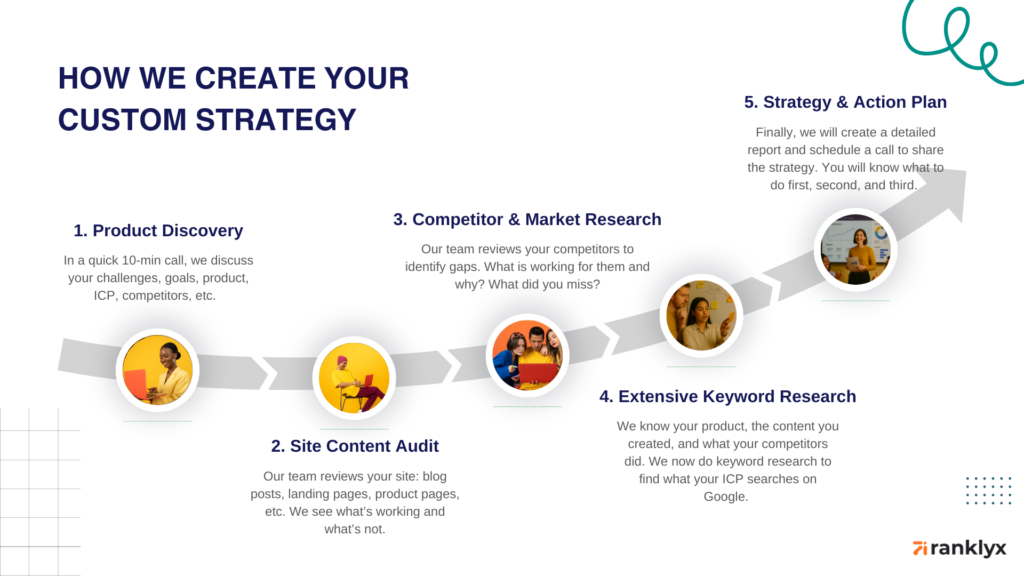
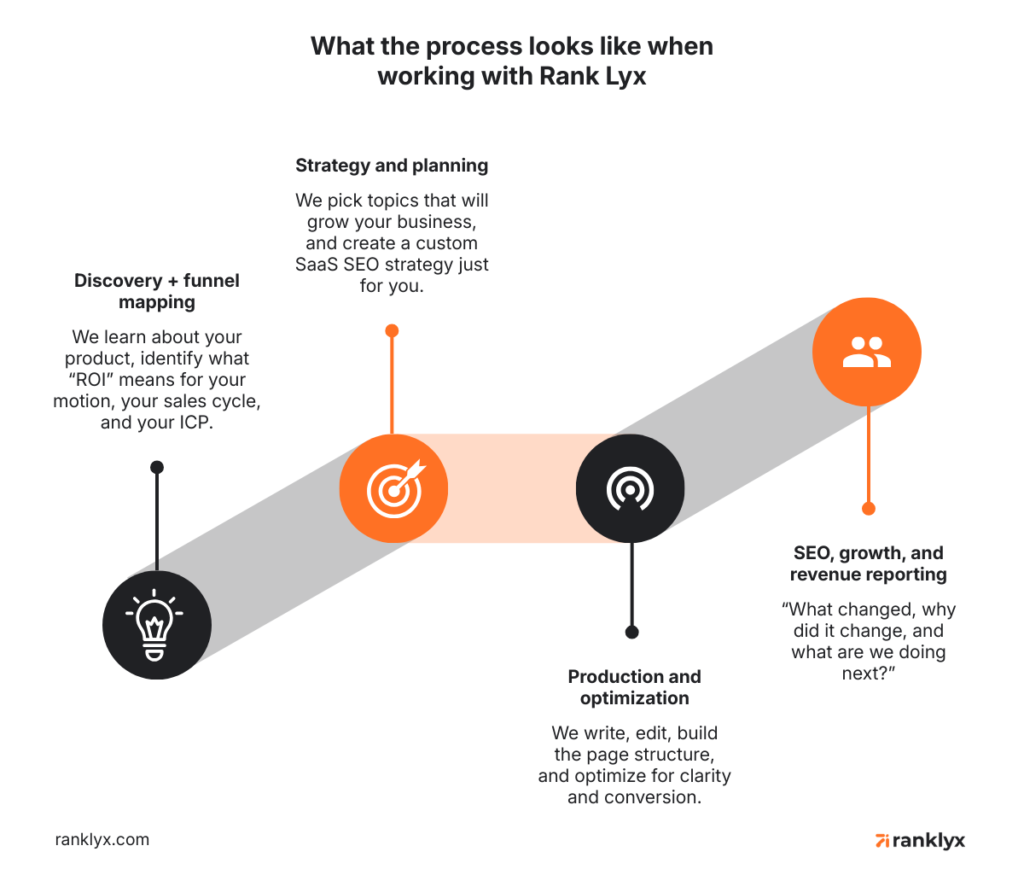
Here is the typical process looks like when working with Rank Lyx:
Discovery + funnel mapping: We learn about your product, identify what “ROI” means for your motion, your sales cycle, and your ICP.
Strategy and planning: We pick topics that will grow your business, and create a custom SaaS SEO strategy just for you. We also plan post purchase and retention content.
Production and optimization: We write, edit, build the page structure, and optimize for clarity and conversion.
SEO, growth, and revenue reporting: “What changed, why did it change, and what are we doing next?”
Then we build the supporting content that strengthens those pages and keeps you ranking.
What you can expect in the first 90 days
Here is what you can expect in the first 90 days when working with Rank Lyx.
Days 1–30: set the foundation and ship the first priority work
SEO and GEO/AEO Strategy and prioritization
Fix the obvious SEO and technical blockers
Launch initial BOFU/MOFU pages
Put tracking in place for conversions and intent
Days 31–60: expand coverage and strengthen internal structure
Publish more decision-stage pages
Add supporting content that feeds those pages
Improve internal links, page UX, and conversion paths
Start authority work for the pages that need it
Days 61–90: push for traction and iterate fast
Refresh what’s underperforming
Add comparison/use-case clusters where gaps show up
Scale what’s working instead of forcing what isn’t
Tighten reporting around pipeline signals
Do results always show by day 90? Not always. But you should see real movement in the right places if the execution is strong and the targets make sense.
Who Rank Lyx works best for (and who should skip it)
You’ll get the most out of Rank Lyx if:
Your product already solves a real, paid problem (seems obvious, but… yeah)
You want more demos, trials, and sales conversations from organic search
You can commit to a multi-month runway instead of a quick “SEO sprint”
You’re tired of content that wins traffic but loses customers
You should probably skip Rank Lyx if:
You only want a high volume of blog posts every month, no matter the topic
You want ranking promises (nobody honest can guarantee that)
What to ask on a first call (so you don’t get sold vibes)
If you’re evaluating any agency, these questions make the difference:
Which pages will you prioritize first, and why? If they can’t answer clearly, they don’t have a plan.
How do you decide between two keywords that both look good? Listen for intent, business potential, and win-ability. Not “search volume.”
How will you prove this work drives demos or trials?
If they only talk about traffic, you already know the outcome.What happens if a page doesn’t perform? You want iteration, not excuses.
How do you handle link building safely? If they dodge specifics, that’s not a good sign.
Work with a SaaS marketing agency that focuses on ROI
If you take one thing from this post, let it be this: ROI-focused marketing starts where buyers make decisions.
When you line up high-intent pages, solid technical SEO, smart internal linking, and careful authority building, your traffic stops being noise and starts turning into demos.
Rank Lyx exists for that outcome. Keep the work consistent, review what converts, and iterate.