-
 Piaff Dibota
- Blog
- Updated on August 11, 2025
SaaS marketing agency pricing: How Much They Charge in 2025!
SaaS marketing agency pricing can be a shock.
Ask three agencies and you’ll get three wildly different answers
One quote feels like a steal. The next makes you question your life choices.
The funny thing is, there’s no universal truth here.
What you’ll pay in 2025 depends on a mix of strategy, timing, and how much you’re willing to push back when you hear the first quote.
So, how much does it cost to hire a SaaS marketing agency in 2025?
Let’s find out!
Key Takeaways:
- In 2025, a SaaS marketing agency typically charges between $2,000 and $30,000+ per month. This pricing depends on the scope, strategy, and deliverables.
- SaaS marketing agencies commonly use four pricing models, including hourly rates, monthly retainers, project-based, and performance-based fees
- Project scope, complexity, funnel stage, deliverables, agency expertise, and expected results affect the cost of hiring a saas marketing agency.
Common SaaS Marketing Agency Pricing Models
Common SaaS marketing agency pricing models include:
- Monthly retainers
- Project-based pricing
- Performance-based pricing
- Hourly consulting
Let’s review each model in more detail.
1. Monthly Retainer
You probably know most SaaS marketing agencies work on a monthly retainer.
It means you’re paying a fixed amount each month for a defined set of services. It’s the most common setup, and it makes planning way easier.
Most monthly plans start at $3,000 to $5,000 per month for lighter content work, like 4 blog posts and SEO support).
On the other hand, more comprehensive packages that include strategy, content, paid media, and reporting can climb to $10,000 to $20,000 per month, depending on your needs.
Some agencies offer tiered retainers. For example:
- Basic: Blog content + light SEO
- Growth: Content + SEO + LinkedIn ads
- Enterprise: Full-funnel support + paid + CRO + strategy sessions
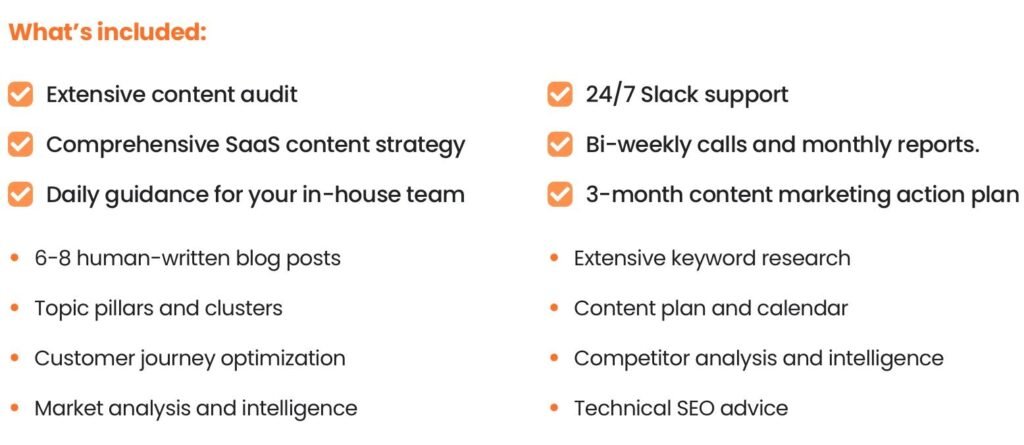
Our pricing at Rank Lyx shows:
- Kick-off: SaaS content strategy + SaaS content writing
- Scale: SaaS content strategy + SaaS content writing + SaaS SEO
- Pinnacle: SaaS content strategy + SaaS content writing + SaaS SEO + SaaS content distribution + email marketing + SaaS demand generation
What I like about retainers is that they create consistency. So it doesn’t feel like you’re chasing new scopes every two weeks.
With the agency, you know what to achieve this month, next, the one after, and so on.
2. Project-based Pricing
Sometimes you don’t need ongoing help (monthly retainer). You just need a thing done.
And that’s where project-based pricing comes in. You pay a flat fee for a specific deliverable or package, and that’s it: no monthly commitment.
For example, let’s say you want a content strategy built from scratch. An agency might quote you $4,000 to $7,000, depending on the depth.
Or maybe you need 10 SEO-optimized blog posts. That could range anywhere from $2,500 to $6,000, depending on the agency’s experience and how niche your product is.
I’ve seen SaaS companies use project-based pricing for:
- Landing page overhauls
- Website copy
- Ad campaign builds
- Email nurture flows
- Rebranding kits
The 2022 SoDA Global Agency Landscape Study found that 72% of agencies primarily use this pricing model.
For many marketing agencies, it drives 30% or more of their annual revenue. Probably because it works for their clients too.
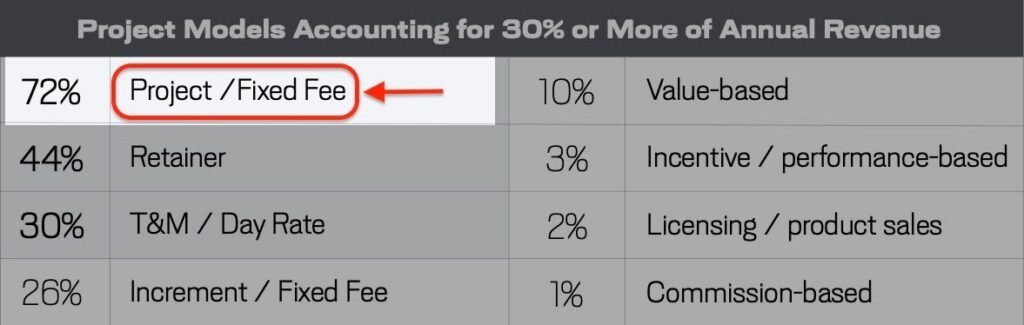
The good part with project-based pricing models, you know exactly what you’re paying for and when it’ll be delivered.
But you’ve got to be crystal clear on the scope, timelines, and rounds of revision because once the project’s done, it’s done.
This is a great option if you want to test an agency before signing a long-term retainer. It’s like dating before marriage.
Let’s continue with the next saas marketing agency pricing model.
3. Performance-based Pricing
Now this one sounds exciting on paper: “You only pay if we deliver results.”
That’s the promise of performance-based pricing.
But let me be real with you: performance-based pricing is rare in the B2B SaaS industry, and for good reason.
Agencies that offer this model usually tie their fees to specific outcomes like qualified leads, pipeline growth, or even booked demos.
For example, they might say:
“We’ll take a base retainer of $2,000 per month and earn a bonus for every MQL above your monthly target.”
It sounds great.
I mean, who doesn’t want guaranteed results?
But here’s the catch: defining and tracking “success” gets messy fast.
Who gets credit for the lead? What if sales drops the ball? What if the funnel takes 90 days to convert?
That’s why most agencies either avoid this model or use it with a base fee to cover fixed costs.
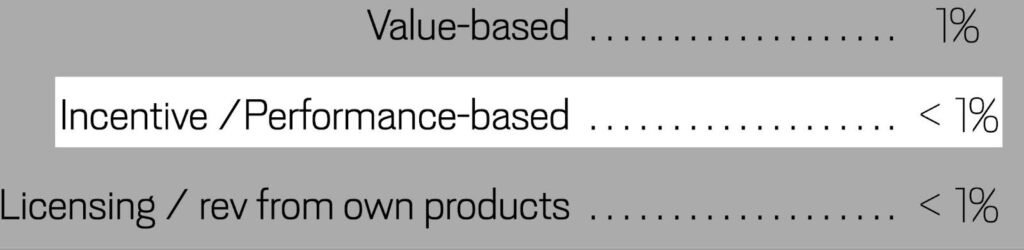
Still, if you find a marketing agency confident enough to do it (and you’ve got strong attribution in place), it can be a solid setup.
Just make sure everyone agrees on the numbers before anything kicks off.
Let’s review one more saas marketing agency pricing model.
4. Hourly Consulting
Hourly consulting sounds simple: you pay for the agency’s time, just like hiring a lawyer.
Need two hours of strategy?
Pay $175 to $199 per hour like this 2025 Promethean Research survey reports.
The survey found that 36% of digital (or marketing) agencies charge that figure while 32% charge $200 to $249 per hour.
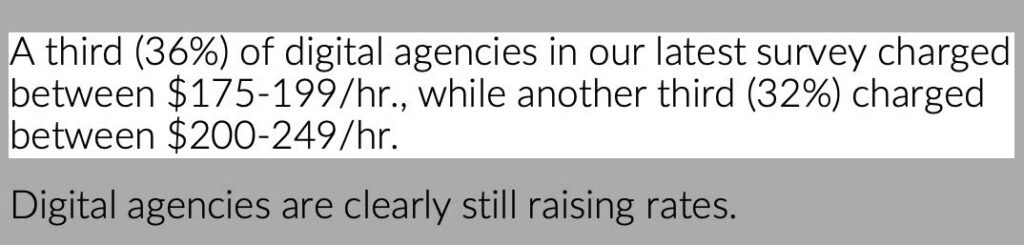
So you’re likely to pay any of these figures as an hourly rate.
If you want the agency to review your funnel or run a messaging workshop, that’s another few hours on the clock.
But the truth is, hourly work doesn’t scale well for most SaaS companies.
You might burn through $2,000 in consulting hours without much to show for it, because SaaS needs execution, not just advice.
Let’s say you’re paying $240 per hour.
A content audit might take 4 hours. A strategy call? 2 hours. Suddenly, you’re six hours deep and still have to do the work yourself or pay again for them to do it.

Hourly consulting can work if you just need short-term help like reviewing a GTM strategy, training your in-house team, or gut-checking a rebrand.
But for ongoing campaigns, content production, or anything full-funnel, it gets expensive fast.
So yes, it’s flexible, but unless your needs are super specific and short-term, I’d keep hourly consulting in your back pocket, not as your go-to model.
Now that you know the most popular saas marketing agency cost models, let’s answer an important question.
Which Pricing Model is Best for Your SaaS Company?
If you need consistent output and an ongoing strategy, go with a monthly retainer. It’s predictable and scales well.
If you want to test an agency before going all in, start with a project, though most agencies will not accept the test.
Use the hourly pricing model for audits or short-term support. It’s not so great if you need execution.
Choose performance-based pricing only if attribution is airtight and incentives are crystal clear. It’s tempting, but tricky.
Factors Influencing SaaS Marketing Agency Pricing
Now that you’ve got a feel for the pricing models, let’s talk about what drives those numbers up (or down).
Factors that influence the cost of hiring a SaaS marketing agency include the
- Scope of service
- Complexity of your GTM model
- Funnel stage covered
- Complexity of your SaaS product
- Volume of content
- Agency’s expertise in your niche
- Expected results
- Agency’s reputation
Let’s review each point.
1. Scope of Services
The first thing that seriously impacts agency pricing is scope.
I know that sounds obvious, but it’s easy to underestimate just how much the scope drives cost.
If you only need blog content and some light SEO, you might be looking at $3,000 to $5,000 per month.
But once you start layering on strategy, paid media, landing page copy, CRO, design assets, and lead nurture emails, now you’re in the $10,000 to $20,000+ range.
It’s about complexity, not volume.
If you are asking the agency to do heavy research or write technical content for a developer audience, the cost will be high.
But if it’s simple brand awareness posts, that changes the game.
You have to be honest about what’s needed at the moment. You can scale the scope later. Starting lean and strategic is better than burning through a budget on five disconnected services.
Also, ask for a line-item breakdown of what’s included. It isn’t enough if they say they’ll handle content.
Does that mean strategy, writing, design, publishing, and promotion? Or just a Google Doc?
Know your scope. Define it. Then compare apples to apples.
2. Complexity of Your GTM Model
Your go-to-market (GTM) models also affect the saas marketing agency cost.
If you’re running a product-led growth (PLG) motion, your agency needs to create content that drives signups, supports onboarding, and maybe even nurtures in-app engagement.
That’s not just blog posts; it’s UX-driven, conversion-focused work that speaks to users, not buyers.
With a sales-led model, the focus shifts.
You’ll need thought leadership, sales enablement content, case studies, and campaigns that generate real pipeline, not only top-of-funnel traffic.
A hybrid model? Even trickier.
Your agency has to map content and campaigns to multiple personas across the full funnel, often coordinating with both product and sales teams.
That takes serious strategy, and yes, it costs more.
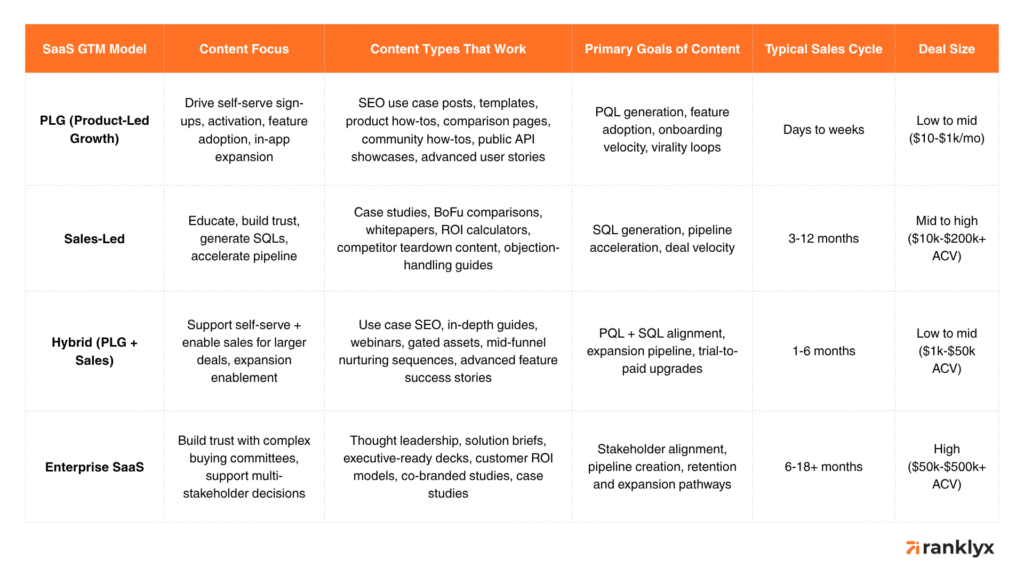
So if your GTM motion is complex, don’t be surprised if the price reflects that. The work gets more nuanced, the buyer journeys are longer, and the messaging needs to flex across channels.
3. Funnel Stages Covered
This one’s big.
The more of the funnel you expect your agency to cover, the higher the price tag.
If you only need TOFU (top-of-funnel) content (blogs, listicles, SEO pages), that’s usually cheaper. You’re paying for reach, awareness, and traffic.
It gets pricier when you ask for MOFU and BOFU work (like white papers, demo nurturing, sales enablement, or product comparison pages).
Why?
Because lower-funnel content requires more strategic thinking, more research, and closer alignment with your sales motion.
Writing a blog is one thing. Writing content that moves someone from “just browsing” to “book a demo” is a whole different beast.
A full-funnel engagement (where the agency handles awareness, lead gen, nurture, and even retention) often involves multiple specialists, not just a content writer.
That’s when you see pricing climb into the $10,000+ range.
So when you engage with a marketing agency, know that the parts of the funnel you are trying to influence will be factored into pricing.
4. Complexity of Your SaaS Product/Market
Some SaaS products are just harder to market than others.
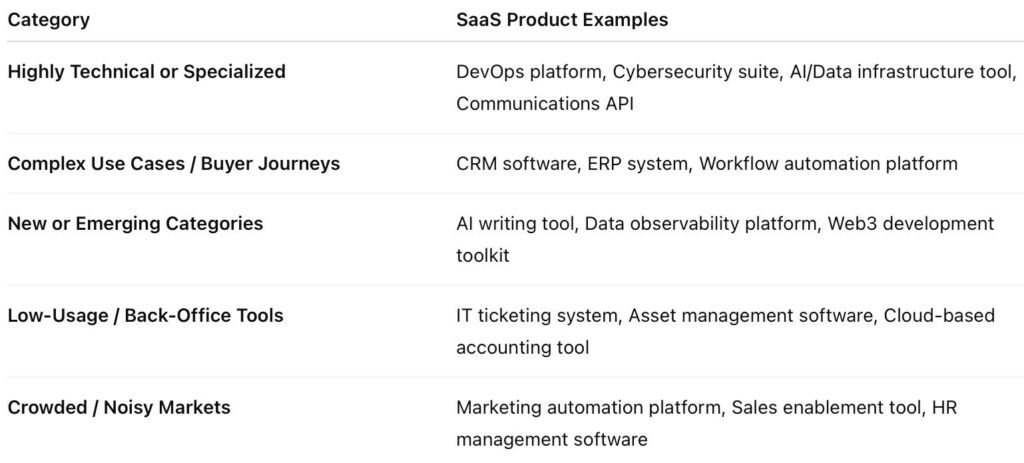
And the more complex your product or industry, the more your agency will charge.
This is because it takes more time, brainpower, and research to get it right.
If you’re in a technical niche, say DevOps, AI infrastructure, fintech, or cybersecurity, simply writing posts isn’t enough.
The agency has to deeply understand your product, your ICP, the market landscape, and often even regulatory nuances.
That’s extra effort, and it costs more.
The same goes if you’re entering a crowded or noisy market. If you’re competing for visibility in a space like marketing and sales, the bar is higher.
You’re trying to out-strategize a dozen well-funded players.
So, expect that to be factored into the price, and make sure you’re paying for expertise, not generic execution.
5. Volume of Content
The volume of content also affects the saas marketing agency pricing.
But there’s a nuance here: the content goes beyond word count. It has to be strategic, consistent, and effective.
Let’s say you want 4 SEO-driven blog posts, two landing pages, a monthly newsletter, and three LinkedIn posts per week.
That’s a serious amount of work.
You’re asking your agency to act like an in-house content engine, and that requires writers, editors, designers, and strategists working in sync.
Now compare that to a company that only needs two blog posts per month and a quarterly white paper.
The scope is smaller, the cost is lower, and the turnaround is simpler.
Also consider things like design assets, custom visuals, copy for paid ads, or email sequences. Those add up quickly.
6. Expertise in Your Niche and Competitive Keyword Landscape
If your SaaS lives in a competitive or technical niche, you already know not every agency can hang.
And the ones who can? They charge more.
Niche expertise isn’t a “nice-to-have;” it saves you time, lifts quality, and drives results faster.
Say you’re in B2B healthcare AI or compliance automation. That’s not beginner territory. You need content that speaks your ICP’s language and ranks for the terms that matter.
An agency with experience in your space might charge more upfront, but you won’t be stuck rewriting posts or explaining what an MQL is.
And if you’re competing for high-intent, bottom-of-funnel keywords like “best procurement platform for SMBs” or “SOC 2 automation software,” you need an agency that knows not just how to write but how to rank and convert.
I think that further explains why they’re usually priced at a premium.
7. Expected Results
Expected results are one more reason that affect a SaaS marketing agency cost.
In simple terms, what you expect in return will absolutely affect what you pay.
If you only want a bit more traffic and some brand awareness, most mid-tier agencies can help (and the pricing will reflect that).
But if you’re expecting pipeline, qualified demos, or revenue growth, you’re playing a different game and paying different rates.
Agencies that deliver serious outcomes don’t just write; they
- Think strategically,
- Run experiments,
- Track attribution and
- Optimize campaigns.
Just like we do at Rank Lyx.
That takes more time, more tools, and more talent.
Want 2x growth in demo requests by Q2?
Expect to pay more than someone just aiming for 500 more visits a month.
8. Agency Experience and Reputation
Here is another point that increases the cost of hiring a SaaS marketing agency: their experience and reputation.
If an agency has helped multiple SaaS brands in your space scale content, improve CAC, or drive real pipeline, they’ll charge more.
And honestly, that premium often saves you time, rewrites, and disappointing results.
For example, an agency that’s worked with seed-stage PLG companies and $100M ARR sales-led teams knows how to tailor strategy.
They’ve already solved the problems you’re facing now, and that shortcut is worth something.
The same goes for agencies that rank for competitive SaaS keywords, are invited to speak at B2B conferences, or publish insightful teardown content on LinkedIn, like we do.
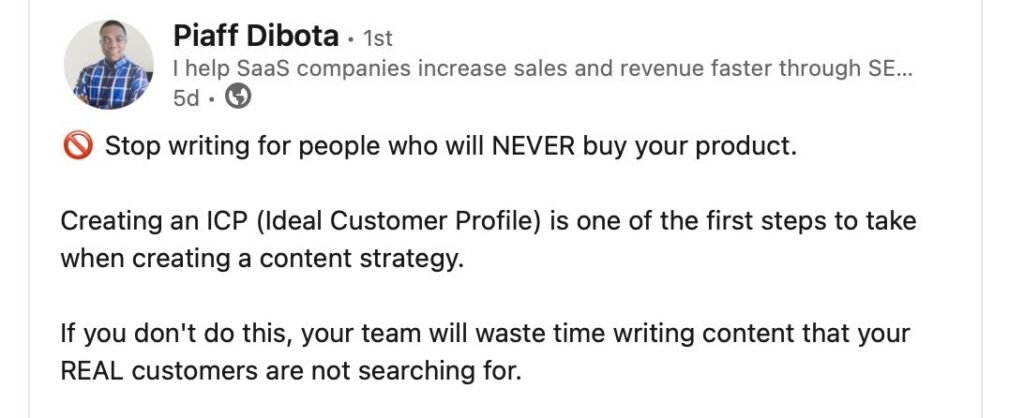
These SaaS agencies have built a reputation and trust, and their rates will reflect it.
SaaS Marketing Agency Cost: To Sum Up
We’ve walked through the most common SaaS agency pricing models, what drives costs up (or down), and how to judge if the investment is worth it.
From CAC payback periods to keyword performance and early wins, you now have the toolkit to make a smart decision.
And if you’re looking for a partner who works closely with you?
That’s exactly what we do at Rank Lyx.
We’ve helped B2B SaaS companies rank for high-intent keywords, reduce CAC, and ship content that moves pipeline.
Request a free site review today! We will review what works and doesn’t, and create a strategy that works for you only.
FAQ
How much does a SaaS marketing agency typically charge per month?
A SaaS marketing agency typically charges between $2,000 and $30,000+ per month. This pricing depends on factors like scope, strategy, and deliverables.
How many blog posts can I expect per month at different pricing tiers?
The number of blog posts you can expect is usually 4 to 8 posts per month at $3,000 to $10,000. Of course, the pricing also includes SEO services.
Are design and graphics included in the pricing?
Yes, design and graphics are sometimes included in pricing. The SaaS marketing agency can design blog headers, social cuts, and landing pages.
How does Rank Lyx's pricing compare to other specialized SaaS marketing agencies?
At Rank Lyx, we’re super transparent and flexible. Our pricing plans help clients see the services they will get before purchasing one of our plans.
Do SaaS marketing agencies offer performance-based pricing?
Some SaaS marketing agencies offer performance-based pricing, but it’s rare and usually tied to lead gen or revenue goals. Most agencies still use retainers.
How long does it take to see ROI from a SaaS content marketing agency?
You can expect to see ROI from a SaaS content marketing agency within 3 to 6 months, especially with SEO or thought leadership work. You see ROI faster if you’re running paid advertising.
Do agencies require long-term contracts?
Some agencies require long-term contracts, locking clients into 6–12 month agreements. This is to ensure stable revenue and allow time for results.
Others offer month-to-month or shorter terms, but usually charge higher rates or limit services for that flexibility.
Does the pricing of a SaaS marketing agency include ad spend, or is that a separate budget?
The pricing of a SaaS marketing agency doesn’t include ad spend. It’s always separate.
You will set your advertising budget. But you’ll pay the agency the agreed contract fee.
Can I test an agency with a small project before committing?
Yes, you can test an agency with a small project before committing. But that depends on the agency’s policy or your company’s reputation.
Generally, agencies don’t accept tests because they want committed clients who want to solve their problems, not testers.
Are there hidden fees I should watch for in agency contracts?
To find out whether there are hidden fees in agency contracts, watch for vague “strategy time,” extra revision fees, or inflated hourly rates.
How do you determine the best marketing agency pricing model as a client?
To determine the best marketing agency pricing model, start with your goals. Need flexibility? Project-based. Want consistency? Monthly retainer.